Port Authority & Terminal Operations
Purpose-built modules for port authorities, terminal operators, and shipping companies — capabilities that distinguish KPOW from general-purpose EHS platforms.
Representative Client Profile
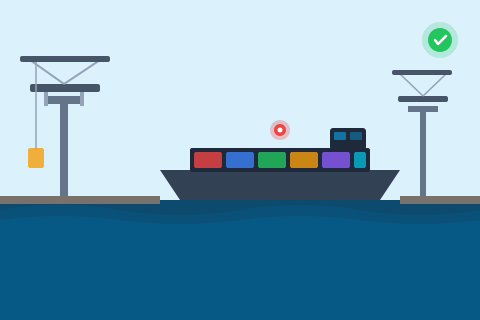
Built for port operations
KPOW includes maritime-specific features that general EHS platforms simply don't offer — from interactive vessel blueprints to Longshore Act compliance automation.
Vessel Blueprint Editor
Map hazards to specific decks, holds, and access points. Edit layouts interactively—drag to resize walls, plot voids, and prepare the layout before the ship berths.
Voyage & Terminal Inventory
End-to-end cargo logistics: track gate transactions, calculate dwell times and storage tariffs, manage delivery orders, and monitor receiving inspections.
Longshore Act Forms
Auto-generate LS-1 (Authorization for Examination) and LS-202 (Employer's First Report of Injury) — unique to KPOW among EHS platforms. PDF generation in under 30 seconds.
Cargo Hazmat SDS Matching
Voyage hazardous cargo summary cross-references cargo manifest UN numbers against your SDS library, flagging unmatched hazardous cargo with warnings.
Union Membership Mgt
Complete integration with CBA steps: track grievances, auto-populate union data during injuries, and slice your KPIs strictly by union affiliation.
Certification Gating
Automatic verification of TWIC, fall protection, and equipment certifications before job assignment. No unqualified workers on the terminal.
How a port authority uses KPOW every day
Follow Terminal Manager Sarah Chen through a typical day at Pacific Gateway Port Authority to see how KPOW supports every aspect of terminal safety and operations.
Dashboard Review
Sarah opens KPOW on her tablet as she arrives at Terminal 3. Her dashboard immediately shows 3 vessels at berth, 2 scheduled arrivals, 1 open hazard from overnight operations, and 12 active jobs. She taps into the vessel blueprint for the MV Northern Star, reviewing pre-mapped hazards — Hold 3 flagged for atmospheric testing due to previous cargo.
Auto-Generated JSAs with Credential Verification
Longshoreman supervisor Marcus Williams reviews the JSA for offloading operations, auto-generated based on vessel type (Bulk Carrier), cargo type (Steel Coils), terminal equipment, and weather conditions. Each crew member acknowledges safety requirements on their mobile devices. KPOW automatically verifies fall protection certification, heavy equipment licenses, and TWIC credentials — all green.
Mobile Reporting in Under 2 Minutes
Forklift operator James notices damaged dock decking near Berth 7. Using his phone, he creates a hazard report: 3 photos, a pin on the terminal map, hazard category (Physical), severity rating (Medium), and a note recommending immediate barricade. The report is auto-routed to Maintenance and Safety. Within 15 minutes, a barricade is placed and a corrective action assigned with a 48-hour target.
Spill Response with Automated Notifications
A minor spill reported at the tank farm. Safety Officer David Park creates the incident, selects the location from the terminal map, and triggers automated notifications to the Emergency Response Team, Environmental Compliance Officer, Terminal Manager, and Coast Guard notification queue. Response documented in real-time: photos, timeline, witness statements, and linked SOPs — all audit-ready.
4-Tab Injury Wizard with Longshore Act Forms
Rigger Pete Nguyen sustains a laceration from a swinging container latch. Safety Officer David Park documents everything using KPOW's injury wizard: employee details auto-populated, nature of injury (Laceration), body part (Left Forearm), claim type (Medical Only), program (Longshore Act). He runs the OSHA Recordability Wizard — OSHA Recordable (sutures required). KPOW auto-generates the LS-202 and LS-1 forms as PDFs in under 30 seconds — a process that used to take 45 minutes with manual forms.
Auto-Generated Reports with Full Audit Trail
Environmental Compliance Officer Lisa Wong generates a preliminary spill report. Because the incident was documented in real-time, the report automatically includes the exact timeline, GPS-tagged location, timestamped photos, responder actions, and linked SOPs. Lisa adds her root cause analysis and submits to the regulatory queue. Regulatory deadlines appear immediately on the Compliance Calendar.
Key features for port operations
| Feature | Business Value |
|---|---|
| Vessel Blueprint Editor | Visually construct and save digital layouts to visualize vessel-specific hazards interactively |
| JSA Auto-Generation | Consistent safety planning based on vessel type, cargo, equipment, and weather |
| Union Tracking & Grievances | Adhere dynamically to established CBA steps directly alongside your injury and risk flows |
| Terminal Inventory Management | Complete visibility connecting operational demurrage, storage tariffs, and physical cargo to your compliance data |
| Certification Tracking | Automatic verification of TWIC, fall protection, and equipment credentials before job assignment |
| Voyage Management | End-to-end visibility of vessel operations, berth scheduling, and cargo tracking |
| Longshore Act Forms (LS-1/LS-202) | Auto-generate forms unique to KPOW — PDF in under 30 seconds vs. 45 minutes manually |
| OSHA Recordability Wizard | Guided determination with audit-defensible classification and override justification |
| Injury Documentation Wizard | 4-tab comprehensive injury capture with nature of injury, body parts, and expense tracking |
| Regulatory Deadline Tracking | Auto-created OSHA and filing deadlines with Compliance Calendar and proactive alerts |
Ready to modernize your terminal safety?
See how KPOW's maritime-specific capabilities can transform your port operations.