Mining & Resource Extraction
Managing extreme hazards — blasting, confined spaces, heavy mobile equipment — while complying with MSHA regulations and coordinating safety across remote locations.
Representative Client Profile
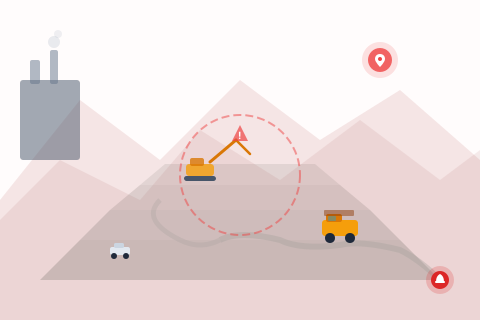
Safety for the most demanding environments
Mining operations face unique challenges — blast protocols, ground stability monitoring, heavy mobile equipment interactions, and fatigue in extreme conditions. KPOW provides the tools to manage them all.
Blast Protocol Management
Digital authorization with exclusion zone activation, GPS-tracked equipment evacuation verification, personnel headcount at rally points, and post-blast inspection checklists.
Ground Stability Mapping
Visual history of geotechnical hazards on pit maps. Track tension cracks, wall stability, and severity changes over time with linked corrective actions.
Fatigue Management
Track hours worked (current and rolling 7-day), time since last break, and days since last day off. Automatic alerts when workers approach configurable thresholds.
MSHA-Ready Documentation
Generate Part 46/Part 48 training records, workplace examination logs, accident reports, hazard communication records, and equipment inspection logs — ready for quarterly inspections.
GPS Equipment Tracking
Real-time location of all mobile equipment. Verify equipment evacuation from blast zones. Auto-populate incident locations from vehicle GPS.
Critical Near-Miss Escalation
Critical-severity near-misses automatically notify Mine Management. Investigation teams auto-assigned based on incident type. Both operators removed from duties pending review.
How a mining operation uses KPOW every day
Follow Shift Supervisor Jake Morrison and his team through a typical day at Red Mountain Mining Corporation's Copper Ridge Open Pit Mine.
Mandatory Safety Briefing with Digital Acknowledgment
Jake conducts the pre-shift safety meeting with KPOW displayed on the muster room screen: blasting scheduled at Pit Level 4 at 10:00 AM (exclusion zone auto-marked), wind advisory triggering dust suppression protocols, and Haul Truck #42 still locked out for transmission repair. The daily JSA for "Pit Level 5 - Ore Extraction and Haul" is reviewed — task breakdown, hazards, controls, and required PPE. All 45 crew members acknowledge on their weatherized mining tablets.
Geotechnical Hazard Tracking
Geotechnical Engineer Maria Esperanza inspects Pit Level 4 before the scheduled blast. She reviews historical hazard pins on the pit wall using KPOW's site mapping, adds a new observation — minor tension crack on the northwest wall, 15cm — links it to the existing "Pit Wall Stability - NW Sector" hazard, and updates severity from Low to Medium. The Blasting Supervisor and Mine Manager are automatically notified.
Digital Authorization and Verification
Blasting Supervisor Tom Redhawk manages the blast protocol through KPOW: exclusion zone activated with push notifications to all personnel within 500m, GPS confirms all mobile equipment evacuated, digital muster verifies all 23 workers at safe rally points, pre-blast atmospheric check logged, and the Mine Manager digitally signs final authorization.
Structured Post-Blast Protocol
Blast executed successfully. KPOW initiates post-blast protocol: 30-minute exclusion with countdown timer, inspection checklist assigned to the Blasting Supervisor, air quality monitoring initiated, and ground stability assessment assigned to the Geotechnical team.
Critical Escalation with Auto-Assignment
A light vehicle nearly collides with a haul truck at a pit road intersection. Haul truck operator Miguel Santos reports via in-cab tablet — location auto-populated from GPS, severity rated Critical (potential fatality avoided). Both operators immediately removed from driving duties. Traffic Management Plan flagged for review. Mine Manager notified automatically. Investigation team auto-assigned.
Automated Hour Tracking and Alerts
KPOW alerts Jake that haul truck operator Ryan Williams has worked 11.5 hours (threshold: 12) and 58 hours in the past 7 days. Jake ends Ryan's shift early, documents the decision in fatigue management records, and assigns a relief operator from the available pool.
Full Claims and RTW Workflow
Maintenance mechanic Daniel Crow fractures his clavicle in a fall. Safety Specialist Karen Whitehorse documents the injury using the 4-tab wizard: fracture, right shoulder/clavicle, lost time claim. OSHA Recordability Wizard determines it recordable with lost-time classification. Workers' comp claim filed same day with $45,000 initial reserve. Two weeks later, a structured return-to-work plan: no lifting over 5 lbs right arm, progressive schedule from 4 hours/day to full duty over 5+ weeks, supervisor automatically notified with full restriction details.
Key features for mining operations
| Feature | Business Value |
|---|---|
| Blast Management Protocol | Digital authorization, exclusion zones, GPS equipment verification, and post-blast checklists |
| GPS-Integrated Equipment Tracking | Real-time location of all mobile equipment with blast zone evacuation verification |
| Ground Stability Hazard Mapping | Visual history of geotechnical hazards on pit maps with severity trending |
| MSHA-Ready Reporting | Generate Part 46/48 training records and inspection logs instantly for quarterly inspections |
| Fatigue Management | Automatic alerts when workers approach configurable hour, break, and day-off thresholds |
| Critical Near-Miss Escalation | Automatic management notification and investigation team assignment for high-severity events |
| Workers' Comp Claims | Full claims lifecycle with reserve tracking and carrier integration for remote operations |
| Return-to-Work Plans | Structured RTW with physician restrictions and progressive schedules for remote site logistics |
| Injury Analytics | Body part heat maps, timing heatmaps, and tenure analysis to drive targeted safety interventions |
| Emergency SDS Access | QR code scanning and emergency quick-lookup for immediate SDS access during chemical incidents |
Ready to manage safety in extreme environments?
See how KPOW can help your mining operation reduce risk, achieve MSHA compliance, and protect your workforce.